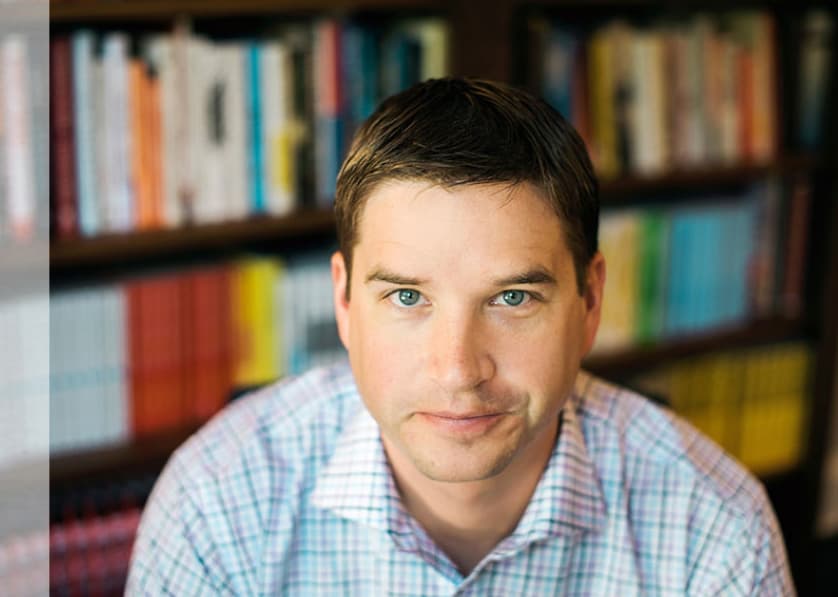
Photo: calnewport.com
Georgetown computer-science professor and bestselling author who built the intellectual case for focused work in a distracted age.
Field / lens: Deep work, attention, digital minimalism, slow productivity
Based in: Washington, DC area (Takoma Park, Maryland), USA
Timezone: ET (UTC−5/−4)
Why they matter to the Guild
Newport gave the tools-for-thought world a vocabulary for attention as the scarce resource: deep work, shallow work, attention residue, digital minimalism. Where much of the Guild’s lineage is about building systems to capture and connect more, Newport asks the prior question — what deserves your focus in the first place, and what should never enter the system at all. He belongs on the map as the field’s most rigorous voice on subtraction, holding useful tension with the more-is-more instinct of digital PKM.
The arc of their work
- Before — Student-success books (How to Win at College, How to Become a Straight-A Student, How to Be a High School Superstar) and the career-advice argument of So Good They Can’t Ignore You (2012): skill, not passion, is the path to work you love. The Study Hacks blog (started 2007) is the through-line.
- The landmark — Deep Work (2016) named the central idea and made it canon: distraction-free concentration is becoming rarer exactly as it becomes more valuable.
- After — He extended the thesis outward and inward: Digital Minimalism (2019) to personal tech, A World Without Email (2021) to organisations, and Slow Productivity (2024) to the pace and volume of knowledge work itself. Alongside the books he runs the Deep Questions podcast (since 2020) and writes for The New Yorker.
Key ideas and terms
- Deep work — Cognitively demanding, distraction-free work that pushes your abilities to their limit and creates rare value. See Glossary — Shared Language.
- Shallow work — Logistical, easily replicable tasks done while distracted; minimise it. See Glossary — Shared Language.
- Attention residue — Switching tasks leaves part of your attention stuck on the previous one, degrading the next. See Glossary — Shared Language.
- Digital minimalism — Choosing online activity by value alignment rather than default adoption. See Glossary — Shared Language.
- Slow productivity — Do fewer things, work at a natural pace, obsess over quality. See Glossary — Shared Language.
Their works
Books
Talks / major articles / blog series
Find them
- Site: https://calnewport.com/
- Newsletter / blog: Study Hacks — Study Hacks - Decoding Patterns of Success - Cal Newport
- YouTube: https://www.youtube.com/@CalNewportMedia
- Podcast: Deep Questions — Podcasts & Videos - Cal Newport's Audio & Video Content / https://www.thedeeplife.com/
- X / Twitter: does not maintain a personal social-media presence (a deliberate position; see Digital Minimalism)
- Other: Contributing writer, The New Yorker; faculty page at Georgetown University
Related leaders
- Tiago Forte — Productive tension: Forte’s Second Brain embraces a digital tool ecosystem; Newport is wary of tool sprawl and argues for subtraction. Same problem (knowledge overload), opposite default.
- David Allen — Both address knowledge-work overload. Allen’s GTD captures and organises every commitment; Newport asks how few commitments to take on at all.
- Greg McKeown — Strong philosophical alignment: Essentialism and Slow Productivity both argue “less but better.”
Sources
- Cal Newport, About and Writing, calnewport.com
- Cal Newport, My new book: Slow Productivity and Podcasts & Videos
- Cal Newport, Wikipedia (bio, titles, Georgetown appointment)
- Slow Productivity, Penguin Random House
- Vault: Cal Newport