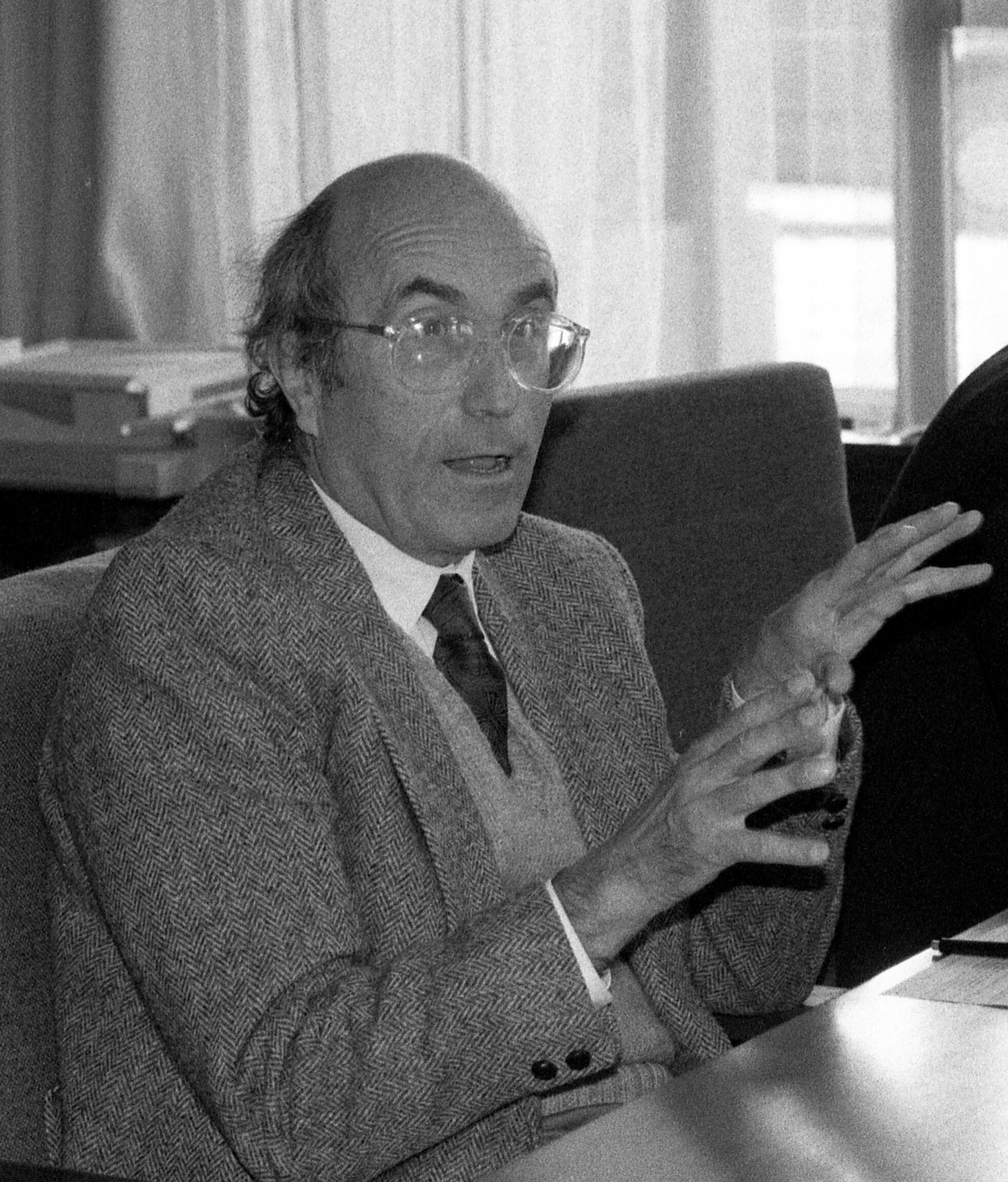
Image: Niklas Luhmann — Universitätsarchiv St.Gallen, HSGH 022/000941, CC-BY-SA 4.0 (via Wikimedia Commons). Browse the actual cards at the Niklas Luhmann Archive.
[needs image URL — a photo of the physical slip box itself; source: https://niklas-luhmann-archiv.de/ ]
The original slip box — a densely linked, paper card system that worked as a thinking partner, not an archive.
Type: method / landmark practice (no single publication — it is the system itself)
By: Niklas Luhmann
When: built ~1951–1997 (begun early 1950s, maintained until his death in 1998)
Where it sits in their arc: the landmark
Where to get it / explore it: Browse the digitised cards online — https://niklas-luhmann-archiv.de/
What it is
The Zettelkasten (“slip box”) is the paper-card note system Luhmann built and used for roughly fifty years — about 90,000 cards joined by tens of thousands of cross-references. It is not a book and not a single artefact you “read”; it is a way of working that the rest of the PKM field has been reconstructing ever since. Bielefeld University has digitised and indexed the cards (over 73,000 processed, with transcriptions and extracted links) as part of a long-term research project, so you can now click through the network Luhmann built by hand.
Core ideas
- Atomicity — One idea per card, fully expressed, so it can stand alone and be reused in many contexts.
- Permanent IDs — Each card has a fixed branching number (e.g. 21/3d7), so links never break and new thoughts slot in beside related ones rather than at the “end.”
- Dense linking over filing — Value lives in the connections between cards, not in any taxonomy. There is no master folder structure.
- Emergent structure — Threads of thought grow organically as branches; the order of the box is discovered, not designed up front.
- The note as communication partner — A mature box surprises its owner: following links surfaces combinations the author had forgotten, generating new ideas rather than merely retrieving old ones.
How it connects to the Guild’s practice
This is the headwater. When a member links notes instead of foldering them, writes one idea per note, or treats their vault as something that “talks back,” they are practising Luhmann. Reading the method directly (rather than only its modern repackagings) is the cleanest way to understand why the link-first lens works. See The Disciplines — Many Lenses, One Room — the Zettelkasten lens.
Related works
- Social Systems — The theory the slip box was built to produce; proof that the method scales to a lifetime’s intellectual project.
- How to Take Smart Notes (Sönke Ahrens) — see Sönke Ahrens — the standard modern on-ramp to this method in English. Canonical: How to Take Smart Notes.
Notes from the room
Space for members to add takeaways and how they used it.