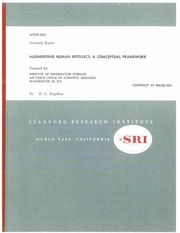
Image: title page of the 1962 SRI report, via Internet Archive
The 1962 report that named the whole field: the case that computers should be built to make human beings, individually and together, better at solving hard problems.
Type: report / conceptual framework (treated here as the landmark work)
By: Douglas Engelbart
When: October 1962 (SRI Summary Report AFOSR-3233, for the Air Force Office of Scientific Research)
Where it sits in their arc: the landmark — the founding statement of “tools for thought”
Where to get it / join: Full text — Augmenting Human Intellect: A Conceptual Framework - 1962 (AUGMENT,3906,) - Doug Engelbart Institute · Scan — Augmenting Human Intellect: A Conceptual Framework : Douglas C. Engelbart : Free Download, Borrow, and Streaming : Internet Archive
What it is
A 134-page conceptual framework, written after a three-year study (1959–1962), arguing that the most valuable thing computers could do was not crunch numbers faster but raise human intellectual capability. Engelbart’s stated goal: “increasing the capability of a man to approach a complex problem situation, to gain comprehension to suit his particular needs, and to derive solutions to problems.” Rather than a product spec, it is a systems-engineering program — a way of thinking about people and machines as one evolving capability. The report won J.C.R. Licklider’s DARPA funding for SRI’s Augmentation Research Center, where the ideas became the working NLS system demonstrated in 1968.
Core ideas
- The H-LAM/T system — Humans Using Language, Artifacts, and Methodology, in which they are Trained. Capability comes from the whole system, not the brain alone; you augment intellect by improving any of those four together.
- Four augmentation means — Artifacts (tools), language (the concepts and symbols we think in), methodology (the methods and procedures), and training. Tools alone do little without the language and methods to use them.
- Co-evolution — The human system and the tool system advance together; redesign one and you must redesign the other. This is why the report reads as much like cognitive science as engineering.
- Bootstrapping — Aim the improvement process at itself: a group that uses its tools to get better at making tools compounds its own capability.
How it connects to the Guild’s practice
This is the deep root of the tools-for-thought lens (see The Disciplines — Many Lenses, One Room). Every time a Guild member treats their note system as a thinking partner rather than a filing cabinet, they are working inside Engelbart’s frame. His “four means” are a quietly useful diagnostic for anyone building a personal system: a member who has the artifacts (Obsidian, plugins) but neglects language, method, and training is exactly the imbalance Engelbart warned about. A short, humbling read on why we build these systems at all.
Related works
- The Mother of All Demos — The 1968 demo is this framework made visible: the abstract program turned into a working system you could watch.
- How can we develop transformative tools for thought — Matuschak & Nielsen explicitly pick up Engelbart’s question and ask it again for the present day.
- The Zettelkasten Method — The analog cousin: Luhmann’s slip box is augmentation of intellect by paper artifact, language, and method, arrived at independently.
Notes from the room
Space for members to add takeaways and how they used it.