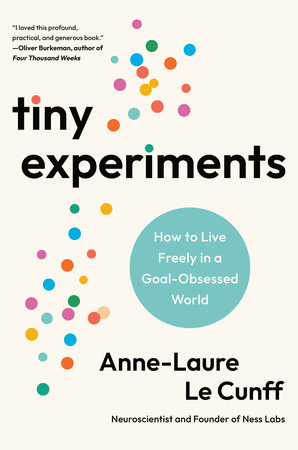
Image: Penguin Random House
A neuroscientist’s case for living by curiosity-driven experiments instead of rigid goals.
Type: book
By: Anne-Laure Le Cunff
When: 2025-03-04
Where it sits in their arc: the landmark — her debut book, carrying the Ness Labs thesis to a wide readership
Where to get it: Tiny Experiments by Anne-Laure Le Cunff - Ness Labs · Tiny Experiments by Anne-Laure Le Cunff: 9780593715130 | PenguinRandomHouse.com: Books
What it is
Tiny Experiments: How to Live Freely in a Goal-Obsessed World (Avery / Penguin Random House, March 2025) argues that the linear “set a goal, grind toward it” model fails us, and offers an experimental alternative drawn from neuroscience and the author’s own path out of Big Tech. Instead of fixed outcomes, you run small, time-boxed personal experiments, observe what the data tells you, and let an authentic direction emerge. It is for anyone who feels stuck inside someone else’s definition of success — knowledge workers, creators, and lifelong learners especially. What makes it distinctive is the pairing of rigorous brain science with a genuinely practical method.
Core ideas
- The experimental mindset — Treat decisions as experiments, not bets; reframe uncertainty as information and self-discovery rather than threat.
- PACT (vs SMART) — Commit to goals that are Purposeful, Actionable, Continuous, and Trackable — focused on the output you control, not the outcome you can’t.
- Procrastination as a compass — Resistance is a signal worth reading, not just a failure to push through.
- Growth as a loop, not a ladder — Replace linear success with a circular model of trial, observation, and adjustment.
- Cognitive scripts — The invisible inherited beliefs (“sequels,” “crowd-pleasers,” “epics”) that quietly set our goals for us, and how to notice them.
How it connects to the Guild’s practice
This is the mindful-productivity / metacognition lens on the shared map (see The Disciplines — Many Lenses, One Room). A knowledge system is only as good as the relationship you have with it: Tiny Experiments gives Guild members a low-pressure way to use their Second Brain — run a pact, capture the observations, review, iterate — without the system curdling into another source of should-do guilt. It pairs naturally with capture-and-connect practice as the “why and how to stay sane while doing it” layer.
Related works
- Ness Labs — the community and newsletter where these ideas were developed in public before the book.
- Slow Productivity — Cal Newport’s adjacent argument for a humane pace; both reject output-as-busyness, hers framed around curiosity and experiment.
- How to Take Smart Notes — pairs well as the capture method to feed the observation half of an experiment.
Notes from the room
Space for members to add takeaways and how they used it.