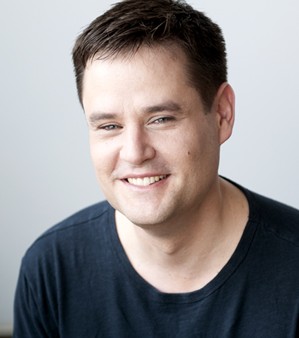
Photo: michaelnielsen.org
Quantum physicist turned open-science advocate and tools-for-thought researcher, who keeps asking how the internet can make us collectively smarter — and how media can be designed so we actually remember what we learn.
Field / lens: Tools for thought, open / networked science, mnemonic media, metascience
Based in: San Francisco, California, US
Timezone: PT (UTC−8/−7)
Why they matter to the Guild
Nielsen is one of the field’s bridge-builders: he came from the deep end of physics — co-author of the standard textbook on quantum computing — and turned that rigor toward the question of how groups of people think together and how individuals retain what they read. His book Reinventing Discovery gave the open-science movement its clearest manifesto, and his collaboration with Andy Matuschak produced the “mnemonic medium,” the most concrete answer yet to the question of how a written medium can be engineered for memory. He matters to the Guild as the co-anchor (with Matuschak) of the tools-for-thought wing: the one who insists that better tools are not just about storage or collaboration, but about expanding what minds — alone and together — can actually do.
The arc of their work
- Before — Australian-American quantum physicist (b. 1974, Brisbane). Co-authored Quantum Computation and Quantum Information (2000, with Isaac Chuang), the field’s standard textbook. Held a Federation Fellowship at the University of Queensland and worked at Los Alamos, Caltech, and the Perimeter Institute.
- The landmark — Left academia (~2008) to study collective intelligence and open science. Helped seed the Polymath Project (2009, with Timothy Gowers), wrote Reinventing Discovery: The New Era of Networked Science (2011), and authored the free online book Neural Networks and Deep Learning (2015). With Andy Matuschak, built Quantum Country and co-wrote How can we develop transformative tools for thought (2019), defining the mnemonic medium and framing tools for thought as a research discipline.
- After — Research Fellow at the Astera Institute. Works on metascience (the “Vision of Metascience” essay), “programmable matter,” and the science-progress questions explored with Patrick Collison. Continues to write essays such as “Augmenting Long-term Memory.”
Key ideas and terms
- Networked / open science — Using the internet to amplify collective intelligence in research, on the condition that the work is shared openly. See Glossary — Shared Language.
- Mnemonic medium — Written media that interleaves spaced-repetition prompts with prose, so reading and remembering become one act. Co-developed with Andy Matuschak.
- Tools for thought as a discipline — Cognitive media as something to be researched and designed rigorously, not shipped as product features.
- Designed serendipity / collective intelligence — Structuring collaboration so that the right people and ideas find each other.
Their works
Books
Tools / experiments
- Quantum Country (with Andy Matuschak)
Talks / major articles / blog series
- How can we develop transformative tools for thought (with Andy Matuschak)
Find them
- Site: https://michaelnotebook.com/ (current) and https://michaelnielsen.org/ (legacy)
- Newsletter: https://michaelnielsenupdates.substack.com/
- YouTube: (no channel; appears as a guest, e.g. Conversations with Tyler)
- Podcast: Good Conversation Project — https://goodconversationproject.com/
- X / Twitter: Michael Nielsen (@michael_nielsen) / X
- GitHub: mnielsen (Michael Nielsen) · GitHub
- Instagram: https://www.instagram.com/michael.a.nielsen/
- Other: Research Fellow, Astera Institute; Google Scholar — Michael Nielsen - Google Scholar
Related leaders
- Andy Matuschak — co-anchor of the tools-for-thought wing; together they created the mnemonic medium (Quantum Country) and co-wrote the field’s manifesto (How can we develop transformative tools for thought).
- Niklas Luhmann — both treat knowledge work as a structured system; Nielsen’s networked-science argument extends the logic of accumulating, linkable knowledge to whole communities.
- Tiago Forte — Forte’s “second brain” emphasises capture; Nielsen’s mnemonic medium is a pointed counterweight, insisting that externalising knowledge is not the same as internalising it.
Sources
- Michael Nielsen — current site / notebook: https://michaelnotebook.com/
- Michael Nielsen — legacy site & blog: https://michaelnielsen.org/
- Reinventing Discovery (Princeton University Press): Reinventing Discovery | Princeton University Press
- Neural Networks and Deep Learning (free online book): http://neuralnetworksanddeeplearning.com/
- Matuschak & Nielsen, “How can we develop transformative tools for thought?” (Oct 2019): How can we develop transformative tools for thought?
- Quantum Country: https://quantum.country/
- Wikipedia — Michael Nielsen: Michael Nielsen - Wikipedia